Navigating security perspectives within the circular economy
The transition to a circular economy is fraught with complexities, particularly when sustainable solutions compete for the same resources. Integrating security perspectives into the circular economy requires a deeper understanding of what those trade-offs really mean for ecosystems, for supply chains, and for the businesses and people who depend on them. Learning to navigate this will be an essential part of steering the circular economy transition effectively.

The way that we produce and consume goods is putting global resource networks under increasing strain. From energy systems to food supply chains, the networks that underpin modern life face mounting pressure: shrinking reserves, access restrictions, rising costs, ecosystem collapse, health risks, and deep inequalities in who bears the burden. These are not purely environmental challenges, they are also resource security concerns. How we respond to them will shape the direction of sustainability transitions for decades to come.
When a resource comes under pressure, governments and industries can typically respond in one of two ways. They can expand supply, by tapping new sources, diversifying imports, or building up strategic reserves, or they can transform the system altogether, by substituting resources and adopting circular principles. The first option is often politically easier and can support resilience in supply chains. The second option is harder, to the extent that it has not yet been achieved at scale, but it is far more likely to address the full range of today’s security challenges. This means addressing not only resource scarcity, but also climate change, biodiversity loss, health risks from novel entities such as synthetic chemicals, and the unequal distribution of both resources and decision-making power.
The exact requirements for reliable availability and access to resources differ depending on whether we are considering material, energy, water or food resource security (see Table 1). The circular economy addresses these differences and can offer solutions tailored to a product’s lifecycle. Taking material security as an example, in the pre-consumer phase, circularity focuses on reducing losses in mineral extraction and manufacturing, recovering by-products, refusing harmful materials and designing products that use less material from the outset. In the consumer phase, the emphasis shifts to avoiding unnecessary consumption by sharing, reusing, repairing, refurbishing, remanufacturing and repurposing products already in use. It is only in the post-consumer phase that recycling enters the picture, through recovering materials from discarded products, or producing new materials from other system waste, such as organic residues. This distinction matters: policies that focus narrowly on recycling only capture one aspect of the circular economy’s potential to contribute to resource security.
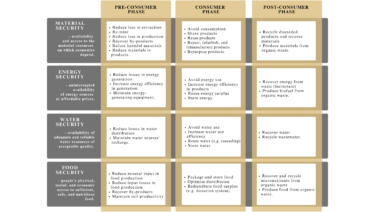
Transitioning to a circular economy presents policymakers with difficult choices. To take batteries for electronic vehicles (EVs) as an example, should policymakers incentivize developers and carmakers to design and build smaller cars requiring less battery power, to minimize resource use? Or should they focus on encouraging service providers to extend battery lifespans to reduce waste? Where should they source the materials from? How should they support recyclers to deal with discarded batteries and recover the critical raw materials? Each decision creates trade-offs and sometimes, hidden conflicts emerge. For instance, promoting repurposing for batteries could potentially extend the waiting time for recycling stations before they receive scrap. When policy pulls in one direction, innovative ideas in the others can get shelved and promising directions go unexplored.
There is no shortage of solutions. The knowledge and technology to reuse, repair, recycle and reduce material in products already exist. What remains stubbornly unresolved is the question of prioritization: which problems are addressed first, whose interests shape those choices and how those decisions are made. Increasingly, the answers to these questions are shaped less by environmental assessments or economic cost-effectiveness than by security concerns. Understanding how security perspectives are currently influencing the agenda is the first step toward making better choices.
In our recent study, we followed the constructivist tradition in critical security studies to explain four distinct ways of thinking about security in relation to the circular economy. We looked at national, human, international and ecological security in turn (see Table 2), to define each perspective’s priorities, blind spots and vision of what a successful circular transformation would look like. In practice, each perspective can determine which circular solutions rise to the top and which are left behind.
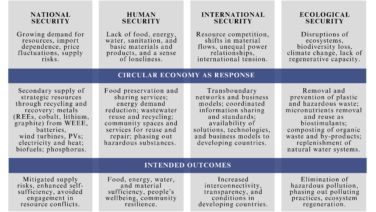
The first is the ‘national security’ perspective. Here, the central concern is dependency: on imported raw materials, a small number of supplier countries, rising costs or supply chains that can be cut off by export restrictions, political instability, or even military conflicts. The materials that matter most under this lens are those deemed strategic or critical, such as the rare earth elements cobalt, lithium, graphite, titanium and phosphorus, whose scarcity threatens not only industry but national defence. The circular economy responses that follow are typically to recycle more and recover critical materials, to restrict the export of valuable scrap, and to convert waste into energy sources to ensure domestic supply. The purpose of the circular economy is seen here as mitigating resource supply risks, promoting greater sufficiency and avoiding resource conflicts with other countries. Left undisputed, this political lens can cause a country to prioritize sovereign control over its secondary resources, shifting towards so-called ‘circular resource nationalism’. The risk is that the ‘national security’ lens pushes circular policies towards post-consumer solutions (see Table 1), which means prioritizing end-of-life recycling over reuse and repair.
The second lens shifts focus from the nation-state to the people: ‘human security’. The concerns here are immediate and tangible, such as: lack of access to food, clean water, energy and basic goods; the health risks posed by hazardous materials; and the social costs of resource extraction, from child labour to local conflicts. The circular solutions that follow are correspondingly often local and community-based: repair and sharing services, second-hand platforms, libraries of things, community fridges and food-sharing apps, household energy-saving measures, wastewater treatment for reuse, etc. This perspective prioritizes reuse and repair over recycling, all to ensure people’s needs are met. By creating local circular networks, these measures aim to support wellbeing and community resilience.
The third perspective is ‘international security’. At the global level, a different set of concerns comes into view, including: competition for resources and technologies bursting into armed conflicts; disruptions and shifts in resource flows; and unequal power relationships within value chains. While the ‘national security’ lens aims to mitigate the effects of international resource conflicts, the ‘international security’ lens questions the external implications of national circular transitions: what economic, social and environmental impact will they have in other countries? Low- and middle-income countries, already marginalized within global value chains, could find themselves locked out of the new circular system, excluded from access to the technologies and circular business models that are benefiting other countries. The solutions of an international security approach deal with governance: creating transboundary circular networks, encouraging the adoption of shared standards and digital product passports, and making deliberate efforts to ensure that the transition works equally in the Global North and the Global South.
The fourth and final is the ‘ecological security’ lens, which places the natural environment at the centre. There is an inherent tension here: securing resources for industry and society often comes at a cost to the ecosystems on which we ultimately all rely for resource security. Seen through this lens, the concerns are disruptions such as climate change, biodiversity loss, plastic contamination of soils and oceans, and the loss of regenerative capacity of natural ecosystems. Circular solutions here include removing contaminants, preventing the generation of plastic and hazardous waste, capturing nutrients from the sea, using organic waste to restore soil health and replenishing natural water bodies with treated wastewater. The expected outcome is both reduced pollution and active ecosystem regeneration. In this sense, the circular bioeconomy – managing biological resources in ways that restore rather than deplete – becomes a key instrument in building long-term ecological resilience.
These four lenses do not always result in aligned policies. Organic and agricultural waste, for instance, can be turned into biofuels – addressing a national security priority for countries such as Indonesia, Brazil and India during the current oil crisis – or into compost and fertilizer for food production, which matters more to human and ecological security. The typology does not resolve these tensions and trade-offs, but it does make them visible and in doing so, reveals something important. The circular economy is not a single destination, but a terrain shaped by competing priorities. Which path is taken depends less on the availability of solutions than on which security concerns are deemed most urgent – and by whom.
One example of a policy instrument in the circular transition is the extended producer responsibility (EPR) policy, which makes producers responsible for the entire lifecycle of their products. Driven by the ‘national security’ lens, this policy would focus on the product's end-of-life stage, including collection, recycling, processing and reusing the recovered materials domestically. Alternatively, the ‘human security’ lens would support product design that incentivizes producers to engage more with repair services and business models that gain profit from product as a service. Corresponding policies would prioritize banning the destruction of unsold products, early separation of disposed reusable goods and the deployment of weatherproof collection containers. Finally, the ‘international security’ lens would aim to generate employment opportunities within a supply chain. Recognizing these alternatives is beneficial for the policymaking process. By evaluating the intended and unintended implications of these security perspectives, stakeholders can develop strategies that align with broader societal goals.
Abstract typologies become concrete the moment they are applied to a real material. Titanium is a good place to start. In the European Union and United Kingdom, titanium is a critical raw material. It is a cornerstone of commercial aviation and defence aerospace that is effectively irreplaceable, as no cheaper or more abundant alternative matches its strength-to-weight ratio and corrosion resistance. As European commercial aviation fleets expand and defence programmes accelerate, demand is set to rise sharply over the next decade. Increasingly, circularity provides a concrete pathway for the EU to reconcile resource constraints with its strategic autonomy objectives.
Figure 1 maps the flow of titanium metal through the EU economy in 2019, indicating three compounding weaknesses. Europe has no meaningful domestic extraction or processing capacity, leaving the entire upstream supply exposed to external disruption before a single component is manufactured. At the primary melting stage, when raw titanium is smelted into usable metal, the EU depends entirely on imported sponge titanium, concentrating supply risk in a handful of exporting countries with no domestic fallback. Finally, about 80 per cent of the material in high-grade semi-finished products is lost to subtractive machining, generating large volumes of valuable scrap that, rather than being retained as a domestic secondary resource, largely leaves the EU under buy-back agreements.
Figure 1: Static material flow analysis of titanium metal in the EU in 2019. Values are in kilotonnes.
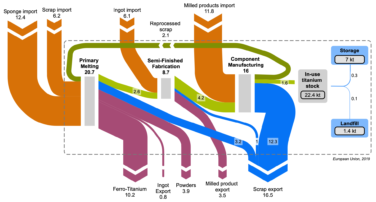
Across this value chain, the United States has long been the EU’s main trading partner, bound by long-standing buy-back agreements: EU sponge access is provided in exchange for pre-consumer scrap its industry could not absorb. However, as the US becomes an increasingly unpredictable partner, these arrangements are turning into traps. The US-Ukraine mineral deal exemplifies this point: Washington has pre-empted EU access to the one nearby country with titanium reserves and processing capacity, locking Ukraine into a bilateral framework that sidelines European partners entirely. The US anchors EU supply while crowding it out of the resources it needs to escape that very dependence.
These vulnerabilities mainly affect the civil aviation sector. Circular solutions can be proposed across the entire aircraft lifecycle to strengthen material security (see Table 1). In the pre-consumer phase, three options stand out: reducing titanium losses in production, recovering by-products and designing new aircraft that require less titanium from the outset. In the consumer phase, circular economy principles support aircraft lifetime extension through product stewardship, reuse, repair, refurbishment, remanufacturing and the retention of components and engines when an aircraft is no longer in use, all of which reduce demand for new titanium. In the post-consumer phase, decommissioned aircraft can be recycled to return titanium back into production; though as the weakest of the three interventions, this depends on a steady stream of end-of-life aircraft that will take decades to materialize. Yet it is precisely this option that the ‘national security’ lens tends to prioritize: current EU policy thinking leans heavily on end-of-life recycling, leaving the faster and higher-yield interventions upstream neglected.
A recent study compared two circular strategies for reducing the EU’s dependence on imported titanium. The first focuses on enhanced domestic supply: retaining pre-consumer scrap not already committed to buy-back agreements and recovering titanium from end-of-life aircraft. The second looks at aircraft lifetime extension, modelled as a five-year increase in average lifespan made possible through expanded investment in maintenance, repair and overhaul. Both strategies improve self-sufficiency and neither comes at the expense of the other, but they do not perform equally.
Retaining pre-consumer scrap delivers the fastest and largest gains. This is the most accessible secondary resource in the entire supply chain, yet a substantial share of it is routinely exported. Retaining and reprocessing it domestically would reduce import dependency more quickly than any end-of-life strategy. Monitoring its flows, attaching conditions to its export and investing in additive manufacturing to reduce scrap generation at source are the highest-return interventions available. Extending aircraft lifetimes, meanwhile, is a demand-side measure that current EU policy has yet to recognize as a resource security instrument: keeping existing planes flying for longer reduces how much new titanium Europe needs to import, without constraining fleet capacity. Certification frameworks that restrict component reuse are a barrier that could be reformed within safety standard limits.
The titanium case makes it clear that the ‘national security’ lens reorders the viable circular solutions for material security. End-of-life recycling, which dominates current EU policy thinking on critical raw materials, turns out to be the weakest of the available interventions: even under optimistic recovery assumptions, secondary supply from decommissioned aircraft would be exhausted within roughly a decade. The real leverage lies upstream, where pre-consumer scrap volumes are larger, material quality is higher and security gains are faster. Exposing which political lens is shaping circular policy – and what it leaves out – is the first step toward challenging the assumptions embedded in it.
The ‘national security’ lens is not the only way to read the titanium case. An ‘international security’ lens would ask both whether the EU’s push for resource autonomy risks replicating the unequal dependencies it seeks to escape – and how developing countries with titanium reserves can become equal partners in the transition. A ‘human security’ lens would ask whether titanium governance delivers sufficiency for communities, not just states, and would lean toward the consumer phase in prioritizing aircraft lifetime extension. An ‘ecological’ lens would treat end-of-life recycling not as a solution to but as a symptom of overconsumption, pushing instead for dematerialization from the outset. The choice facing EU policy is stark: circularity either serves national competitiveness, quietly subordinating ecological and human goals, or it serves wellbeing and planetary boundaries, in which case strategic autonomy must be pursued through fundamentally different means.
There is no neutral position in the circular economy. Every policy decision reflects a set of security assumptions about which risks matter most, which materials are most exposed and which solutions deserve priority. The question is not whether those assumptions will shape the transition, but whether scholars, policymakers, and stakeholders are aware of them when they do.
Three things need to change. Policy interventions should acknowledge circular solutions across the full product lifecycle, not just the post-consumer phase dominated by recycling. There should be coordination across industrial, defence, climate, trade and innovation policy, so that circular targets translate into shared resilience goals rather than competing mandates. Lastly, there should be a genuine effort to surface solutions that serve human, ecological and international security – perspectives that are increasingly marginalized, not because they are ineffective, but because the concerns they address carry less political weight amid heightened geopolitical tensions.
That imbalance has a cost. Circular strategies shaped exclusively by national security priorities will secure supply chains while quietly subordinating the wellbeing of communities, the health of ecosystems and the interests of countries in the Global South. Understanding which political lens is driving the agenda and whose security it serves is the starting point for ensuring that the circular economy delivers on its full promise.
Related insights
-
Can the EU’s battery passport and China’s battery ID become interoperable? 
Can the EU’s battery passport and China’s battery ID become interoperable?
-
Why circularity is indispensable for minerals security 
Why circularity is indispensable for minerals security